

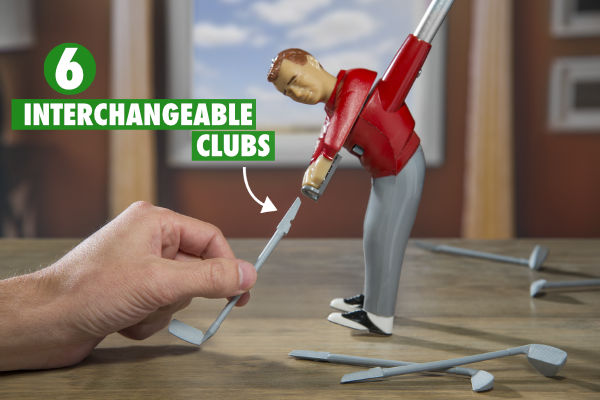
I own a small golfer on a stick toy that I bought at a county fair many years ago. It was a bargain then, only $29.95. Today, the product sells for $59.95, so I knew a good investment when I saw one. Like many who purchased, I was very excited to bring it home and use it. For perhaps a week, I brought it out to hit the tiny golf ball it came with throughout the house. The tiny ball was lost somehow and then my enthusiasm in the game. It came with small clubs too, apparently, I lost those as well. I still have the toy today, thoughtfully in sight – not because I like playing with it. It’s there because it reminds me of a life lesson – do not buy on impulse.
Financial ruin can be accomplished by buying on impulse. It’s easy to justify impulse purchases. In fact, there are a whole bunch of them you can use to justify many purchases: “I work hard, I deserve it”. Or how about this one: “This will be worth something someday” justification. “The neighbor has one so I should too”. “They have one and I know I make more money than they do”. “I always wanted one.” “They don’t make these anymore”. “This is the last one”. “It will be a collector’s item.”
If you need to justify it, you probably don’t need it. Justification might be the best “Red Flag” to purchasing there is. If you have an instant feeling that you need justification, perhaps you don’t need it. Actually, you don’t – you just want it. Remember the difference between want and need.
Needs:
- Shelter
- Food
- Clothing
Wants
- A bigger house
- A vacation home
- A luxury vacation
- An exotic car
When I want something, I ask myself: (I usually conclude I don’t need it.)
- Is it replacing something else I already own, and could or should I sell that one first?
- Is this a unique opportunity to get it now because of some odd circumstance? (Not a justification statement, a real, honest, unique situation)
- Can I really, really afford it (pay cash and not worry about other bills?)
- Will it take time to use that I don’t have?
- Will it cost time against something I already own that I already enjoy doing?
- Will it cost me to store it when I am not using it?
- Do I really have room for it?
- Will it go up or down in value?
- Can I buy it cheaper someplace else? (I almost always can!)
- Do I really know what it is worth? (Would I be overpaying?)
- Can I afford it if I lost my job?
Opportunity cost: Giving up one thing for another. Remember your economics class and opportunity cost? That’s the cost of what you will give up for acquiring what you think you want. Let me give you an example:
I own a Porsche. Don’t be impressed – it’s a used, lowest cost model of the Porsche I have always wanted. It was very inexpensive compared to another Porsche, but I could have bought any number of models of a new car for the same amount I spent on it. New cars have warranties and no miles. With the same money, I could have driven a new car for many years for less cost than my 18-year-old Porsche. That was the opportunity I lost when I bought it. Believe me, I weighed that carefully many times and chose the other car option 4 different times when I decided I was going to buy a Porsche. In fact, I waited 42 years for my Porsche! I never felt bad about that choice when I made it. It was a much smarter and practical decision and still gave me something to drive. (I never bought “New” as cars depreciate, but they were new to me)
When making a purchase, I assume I will be giving up something when I buy, and I weigh that in my mind. For illustration, let’s imagine I financed a car at $500 a month for 60 months. That’s $500 that I will not have access to for 5 years! What else could I have done with that $500?
- Invested it – It could have made me more money. ($500 invested monthly at 7% would produce $35,252 in 5 years. That’s $25,000 I put in to get $10,252 more I didn’t have to work for)
- Given it away – I like supporting things important to me, and $500 could go a long way
- Bought something cheaper for cash or less financed cost– What if my car payment was $250 vs $500 – that gives me $250 more cash flow per month. What if I had just bought a junker for cash?
- Gone on vacation – I have never taken a $6000 vacation, but that would be the same as a year of car payments, so I could.
The importance of a budget and a maximum commitment. In the above statement I said I have never taken a $6000 vacation. I can’t, my budget won’t allow it. The grumbling has already started for some of you – I can feel your justification statements screaming at me. Budget? Bah-humbug.
Wealth building comes from the ability to stay within your means. My budget is my means. I don’t exceed my individual budget allocations by more than $500 in total any year, ever, unless I am paying something off.
Let me explain. When I travel I don’t require 5-star hotels. The marketing people think I do, but I really don’t. It is my goal to spend as little time possible in bed on vacation so it would be silly of me to spend it on my bed. I have some tricks for getting my airfare cheaper, so I use those, meaning I can travel to places for less money than most. My Porsche is more fun and less cost than flying, so when I can, I drive to my destination. Driving there means I always have a car to use and don’t need to rent one, again saving me money. My small car is easy to park, and I know it so well I can park places everyone else drives by and no one kids me about having this small car.
Eating out is a huge travel cost and restaurants and bar alcohol add up quickly. Happy hour though is often a great value and since I prefer lighter meals, I enjoy it more. I do enjoy an occasional gourmet meal and my budget already has it built in.
I don’t have any less fun than most and I don’t worry about a bill I can’t pay or one I need to pay off over time with interest when I get back. My budget is based on what I can afford without adding any debt. Interest is bad mojo when I must pay it to someone else.
If you must borrow money to go on vacation, you shouldn’t go on that vacation. If you use Credit cards and make less than full payment, that is borrowed money. (credit in a card – remember? Credit = loan) Frankly, this is the very worst way to borrow because it is much, much more expensive than if you would have gone to the bank for a personal loan instead. Think of your credit card (if you carry forward any unpaid balances) as incredibly bad mojo.
The power of a budget. I once went to a car dealership and told them which vehicle I wanted and what I would pay for it. They started negotiating and each time they came back with a lower offer, but still higher than what I had told them. After many, many rounds of this, they came back with a note on top of the page written in ink = “you win”. It was still $1000 more than I had told them I was willing and able to pay and I walked out the door. My budget is my budget. It’s what I can afford. (We ended up buying a much cheaper to buy and less expensive to operate vehicle which allowed us to save money for other uses).
Stay away from impulse. If you are the kind of person who is notorious for spending money you don’t have, don’t put yourself in situations that tempt you. Don’t visit the time share sales pitch. Don’t go to the auto show. Don’t go to the pop-up hot tub sale. Avoid temptation and stick to your budget – always. It will be hard at first, until you see your debts melting away and money in the bank. Then it will not feel hard at all.
Financing and instant gratification. Imagine if you could get something for $50 per month vs. $2500 now. It’s not imaginary, it’s real and it’s called financing. There are a few good reasons to finance (0% financing is free money; Financing can free up cash flow for investing) but in most situations, financing is a bad idea.
There is a company that sells exercise equipment that uses financing to motivate people to purchase their impulse item. I calculated their offer once and discovered that if you only ever gave them the minimum payment they used in their ads, it would take you 15 years to pay for the purchase. Yikes! Financing is used by these companies to drive purchases and make the Company more money. I know this better than most, because I created a program for a retailer and increased sales by $45 Million dollars using the finance incentive. 0% financing is great only if you payoff the amount financed within the terms of the offer (12 months interest free paid in 12 months). It will eat you alive if you don’t (and most people don’t and that’s what the bank bets on).
Counseling and advice. If you are an impulse purchaser, you need to stop. That is an easy thing to say, but it is very hard. For me, I turned to budgeting and a concept called pay myself first. You can learn more about that from our mutual friend, Google.
If you know people who are financially stable ask them for advice. Friends will be honest with you. If you are afraid to tell others about your situation, I highly recommend Dave Ramsey and his baby steps program. It’s free, it’s incredibly valuable and you will learn about how to manage your finances and create a plan.
 The Mirror has two faces
Leave a comment